For owners of $5M to $15M businesses

Your business is hiding an extra 20%. AI can find it.

You are almost certainly making more money than you keep. In a business your size, a slice of it slips away every month through the cracks between your systems: the quote that went quiet with nobody to chase it, the extra thrown in to keep a customer happy that never got logged, the loyal account that quietly costs more than it pays, the overtime you only saw after payroll had run. Nobody decided any of it, and by the time you notice, it is already gone. That is not a failing, just what happens when a business outgrows what one person can hold in their head. Independent research puts the number at 8 to 20 percent of revenue. We point AI at the tools you already run, find it, in dollars, and hand it back.

Pick the three you recognize. We’ll come back with what they cost a business your size, in dollars. Or just text us.

The 20% hides inside three questions you can’t answer fast enough

You have a feel for all three of these. That feel is worth something, and it is worth less than a number. Try answering one of them precisely, today, at the level of a single job or customer, without a week of spreadsheet work first. The gap between your gut and a number you can prove is exactly where the money leaks out.

How do we make money?

Not revenue by month. Which customers, jobs, and services actually carry margin once you count the time they really take. Most businesses discover a slice of their work earns almost nothing, and they discover it by accident.

Do more of what pays. Reprice or retire the rest.

How do we spend money?

Where it goes, and which of it is buying something. Part of your spending is paying people you hired for their judgment to re-key data between systems, chase a signature, and rebuild the same report every Monday.

Stop paying for work that should not exist.

How do we invest money?

Where the next dollar of cash, headcount, or equipment earns the best return. This is the question that decides whether the next few years are steady growth or an expensive lesson, and it usually gets answered on instinct.

Expand on evidence. Stabilize what you already have.

Not sure which of the three is costing you most? That is the usual answer.

Pick the three you recognize. We’ll tell you which one is usually costing a business like yours the most, in dollars.

Would rather just talk? Text us, hello@ondework.com, or the contact form.

Ask any of these three questions in your business today and what follows is a scramble. Someone exports from one system, someone else rebuilds a spreadsheet, and a week later you get a number that is roughly right and already out of date. So the call gets made on instinct instead. Your instinct is probably close. The trouble is that close is not defensible, and a decision you cannot defend is one you quietly postpone. That is what uncertainty actually costs: not wrong decisions so much as late ones. The information exists. It is spread across too many places, kept current by hand by people you hired for their judgment and are paying for data entry.

The answers exist. They are just not in one place.

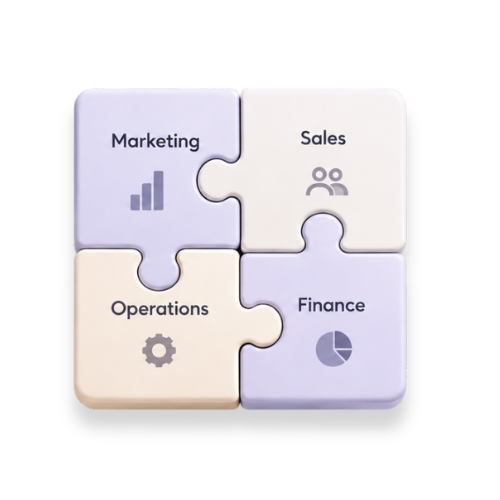
Your information starts scattered across inboxes, spreadsheets, and people’s heads. We connect it into one clear picture of how your business actually works: the things you run on, how they fit together, and who owns what. That picture is what turns the three questions from a research project into something you can just look up.

Once it’s organized, the answers are there when you need them:

  • A clear view of the whole business, down to which job or customer made the money.
  • Reports and spreadsheets on demand, current, not stitched together by hand.
  • AI agents that keep it current and act on it: send the invoice, flag the exception, update the record.

Today: scattered across tools and inboxes

Example, not a client result

Where $180,000 hides in an $8M contractor

What it runs on today

Estimating in one tool. Field hours on paper, keyed into payroll every Friday. Materials arriving as supplier invoices in an inbox. Billing in QuickBooks. Four places, each of them accurate on its own, none of them adjacent to the others.

The question it cannot answer

Which of last quarter’s forty jobs actually made money. Not the quarter as a whole, which the accountant can produce. Job by job. Answering it properly means one person pulling four sources together for an afternoon, per job, so nobody does it, and the business runs on the number it can see instead.

The arithmetic

Take a $250k job bid at 18 percent margin, so $45k. Two changes get built in the field and never make it onto an invoice, call it $9k of work delivered for nothing. The crew runs 120 hours over, another $6k. The job closes at roughly $30k instead of $45k, and nobody sees it until the year-end review, if at all.

One job like that a month is on the order of $180k a year. On $8M of revenue that is more than two points of margin, sitting inside work that looked fine on the schedule.

What changes

Connect the estimate, the field hours, the material invoices, and the billing to the same job, then let automation keep them connected as work happens. Now a change logged in the field reaches billing on its own, and a job trending over its budgeted hours surfaces while it is still running rather than at closeout. The owner stops reconstructing margin and starts looking it up.

You have four other options. Here is where each one lands.

We are not the obvious choice for everyone, and for some of these businesses one of the options below is genuinely the better call.

Carry on as you are

Free, familiar, and working well enough that you are reading this rather than panicking. The cost is that the decisions keep getting made on instinct, and instinct gets more expensive the bigger the business gets.

Hire an operations or analyst person

A real option, and the one we would recommend if the work were ongoing analysis. It is a salary plus six months of ramp, and they will spend their first year building by hand the same picture that should assemble itself.

Have someone wire up automations

Fast and cheap, and it usually holds for about a quarter. Automation built on data that disagrees with itself breaks quietly, and you find out when an invoice goes to the wrong customer.

Buy a system that promises all of it

The heavyweight option. Real money, a year of implementation, and your team learning software instead of doing their jobs. Worth it at a size you have not reached yet.

How it works

It comes down to two moves: first we build one clear picture of how your business works, then we put AI agents on the repetitive work that keeps it current. You don’t get a tool to figure out. You get a team that does both, keeps it running, and hands you answers you can act on.

1. Audit

We find where your hours go, where the information lives, and which of the three questions you cannot answer today.

2. Organize

Your scattered information becomes one connected picture of how the business actually works, structured and yours.

3. Automate

AI and agents take the repetitive work and keep the picture current, wired into the tools you already use.

4. Run

We monitor, tune, and keep finding the next thing worth fixing. The answers get sharper every month.

Sound familiar?

None of these mean anything is going wrong. They are just what a business looks like once it grows past the point where one person can hold it all in their head.

The Monday report that lands on Wednesday

Someone in your office rebuilds the same numbers every week out of four different places. By the time it reaches you, you are making this week’s decisions on last week’s picture.

The job that felt like a winner

It finished on time, the customer was pleased, the crew was busy the whole way through. Whether it actually made money is a question nobody has a spare afternoon to answer properly.

The quote you priced from memory

You have done a hundred of these and the number you gave is probably about right. Probably. The last time anyone checked what that work really costs to deliver was a while ago.

The hire you still cannot grade

Eighteen months on, the business is bigger. Whether that is because of them, or would have happened anyway, nobody ever sat down and separated out.

If one of those landed, that is the place to start.

Pick the three you recognize. We’ll come back with what they typically cost a business like yours, in dollars.

Would rather just talk? Text us, hello@ondework.com, or the contact form.

What it costs, and what you’re committing to

We don’t publish a price list, because the number depends on what your business runs on and how tangled it is. A business with everything in QuickBooks and two spreadsheets is a different job from one running four systems that disagree. Quoting either from a website would be guesswork.

What we can tell you is the shape of it, and we will give you a real number early:

  • We scope first, then quote. You get a number before you commit to anything, and it does not move once we agree it.
  • You own everything we build, and the data stays yours. If you stop working with us, you keep the picture and the automations.
  • No software licence to buy from us, and no long contract. We stay because the work keeps earning its keep.
  • We only build what pays for itself. If we cannot see how something returns more than it costs, we will tell you rather than build it.

Want a sense of the number for a business your size?

Pick your three and we’ll come back with a realistic range before you spend any time with us.

Would rather just talk? Text us, hello@ondework.com, or the contact form.

What owners ask before they start

Are you going to replace my people?
No. We take the repetitive work off them so their time goes back to the work you actually hired them for. In most cases the person freed up moves onto something that produces revenue, like collections or customer follow-up.
Does this work with QuickBooks and the software we already run?
Yes, and we would rather connect what you have than replace it. No rip-and-replace, no new system for your team to learn, no migration project. Your existing tools keep doing their job.
Our data is a mess. Is that a dealbreaker?
It is the normal starting condition and it is the reason to call, not a reason to wait. Every business at this size has information spread across inboxes, spreadsheets, and people’s heads. Sorting that out is the first half of the work.
How much of my team’s time does this take?
Most of it lands on us. We need some hours from whoever knows how the work really flows, usually an office manager or a lead, concentrated at the start rather than spread over months.
What if we stop? Do we lose everything?
You own what we build and the data stays yours. That is the point of organizing it in the first place. If you stop working with us, you keep the picture and the automations.

Find out what your 20% is worth.

Pick the three leaks you recognize. We’ll come back with what they cost a business your size, in dollars, and what it would take to close them. If the number isn’t worth chasing, we’ll tell you that too.

Text us
  • A real person, not a bot
  • No sales calls, no sequence
  • Straight answer, even if it’s no